.png)
For many people living with complex chronic illness, symptoms can change quickly and without warning. That unpredictability can make daily life very hard to manage.
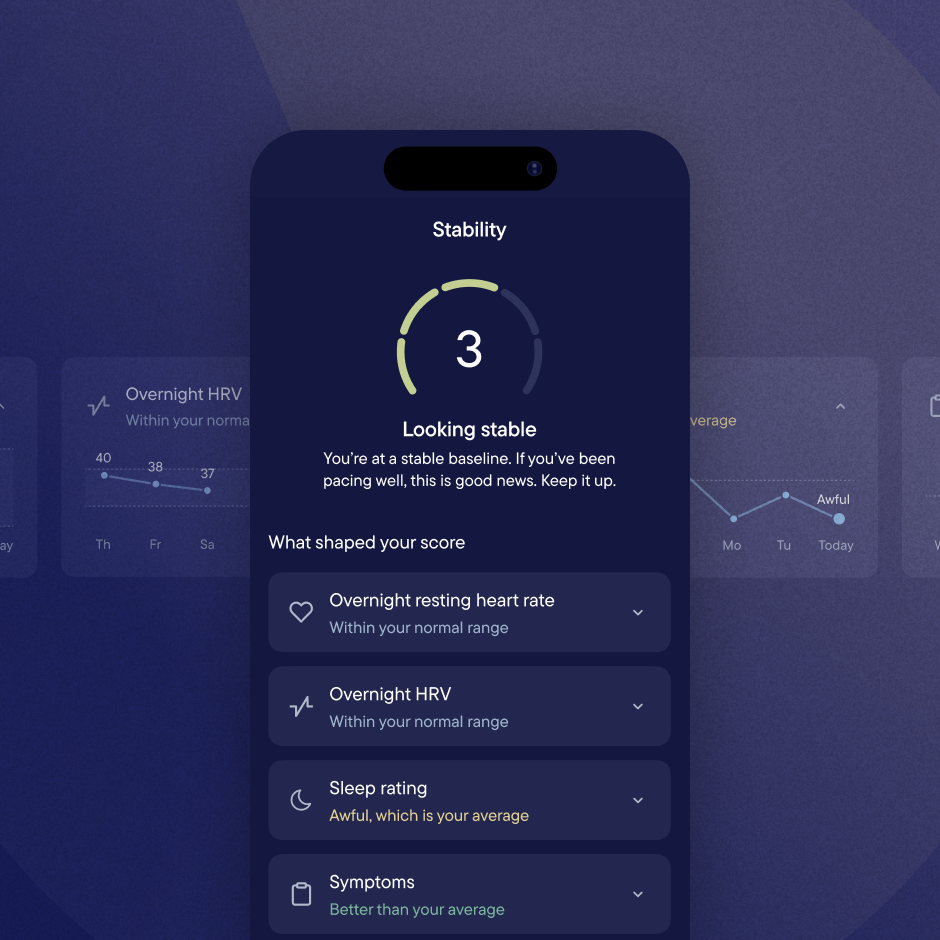
That’s why we built Visible’s Morning Stability score. It brings together your biometrics and recent symptom patterns to indicate when your body may be under more strain than usual. This can help you plan your day with more confidence.
Today, we’re sharing a new peer-reviewed study on heart rate, heart rate variability (HRV), and symptom changes in people living with complex chronic illness. These are the signals behind the Morning Stability score. Thanks to Visible members, it is the largest study of its kind.
What the researchers did
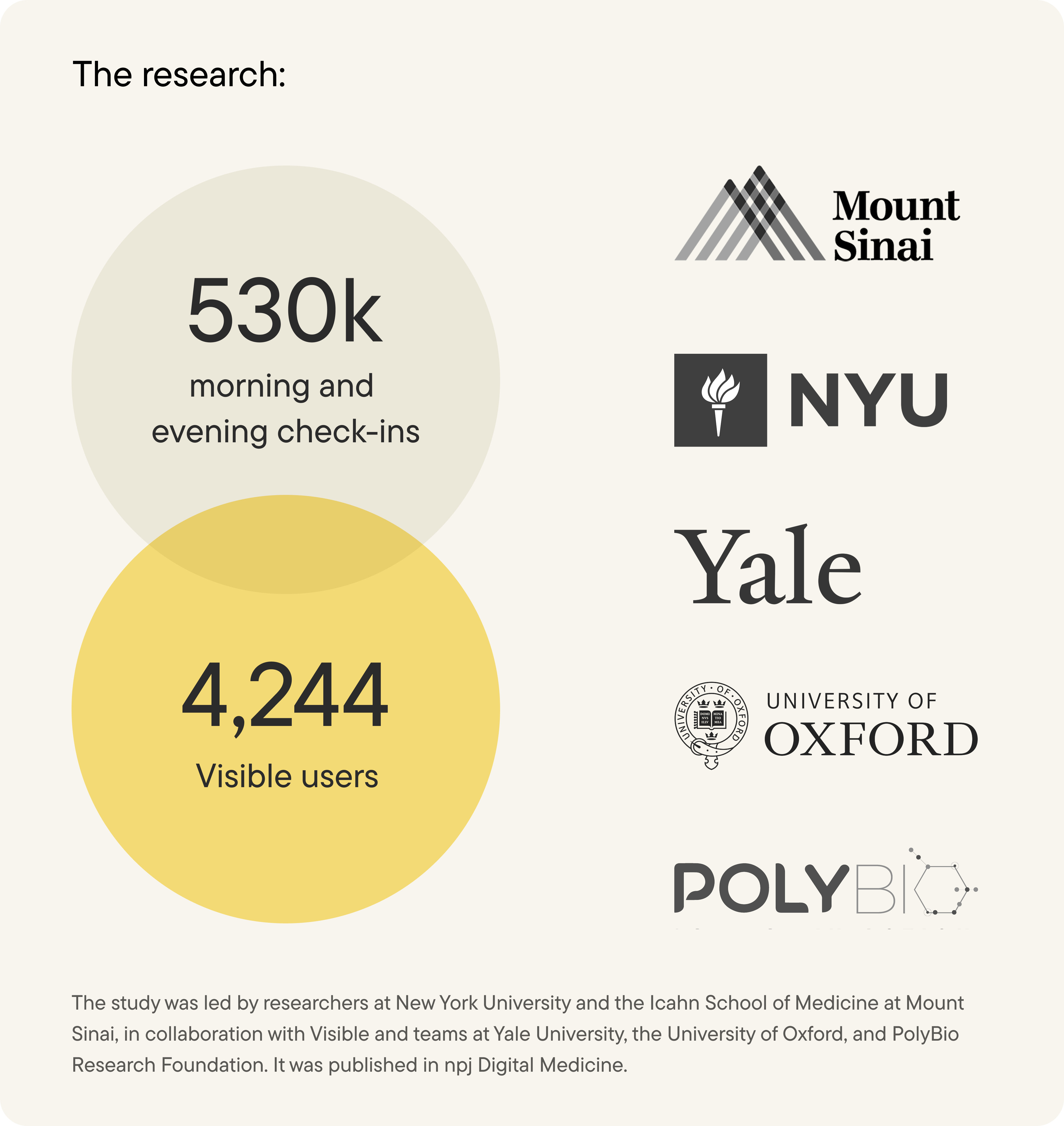
The researchers looked at data from 4,244 Visible users who consented to take part in the study. In total, they analyzed more than 530,000 matched morning and evening check-ins.
If you use Visible, you'll already be familiar with these daily check-ins:
- The 60-second morning check-in that uses your smartphone camera or Visible band to measure heart rate and HRV.
- The evening check-in, where you log things like crashes, fatigue and brain fog.
Using this data, the researchers explored whether morning biometrics, combined with recent symptom patterns, could help predict worse symptoms later that day.
The study was led by researchers at New York University and the Icahn School of Medicine at Mount Sinai, in collaboration with Visible and teams at Yale University, the University of Oxford, and PolyBio Research Foundation. It was published in npj Digital Medicine.
Morning biometrics were linked to symptom worsening later that day
The researchers found:
- When morning heart rate was higher and morning HRV was lower, people were more likely to report crashes, fatigue and brain fog later that day.
- How people felt the day before was already a strong clue to how they would feel later, but adding morning biometrics improved those predictions.
- Personalization mattered. The models worked best when based on each person’s usual baseline, rather than a one-size-fits-all approach.
- Day-to-day variation also mattered. People whose heart rate and HRV changed more over a rolling seven-day period were more likely to experience worsening symptoms.
Lead researcher Annie Aitken, PhD, of NYU, said:
“Morning biometrics appear to provide an early signal of symptom worsening later in the day. For people living with these conditions, that kind of information could support more informed pacing and activity decisions, helping people reduce the risk of overexertion and symptom escalation.”
The largest study of its kind, focused on outcomes that matter to patients
Most research on HRV and heart rate happens in lab settings using specialist equipment. This study took a different approach in several important ways.
- Data collected outside the lab, using smartphones people already own.
- Instead of comparing people with complex chronic illness to healthy controls, researchers tracked changes within each person over time.
- A focus on what actually matters to people living with these conditions: crashes, fatigue and brain fog.
- At 4,244 people and more than 530,000 matched check-ins, it's the largest study of its kind to date.
Study co-author Professor David Putrino of Mount Sinai said:
“This is the first time we’ve been able to show, in the largest study of its kind to date, that simple morning biometric- and symptom-tracking hold predictive value for the day-to-day outcomes that people with complex chronic illnesses care about most, including crashes.”
What this does (and doesn't) tell us
As with any study, it’s important to be clear about what this one does and doesn’t show.
This study shows that even a single 60-second biometric reading can identify meaningful patterns in complex chronic conditions. It also shows that these signals are most useful when combined with recent symptoms, and when looked at over time rather than in isolation.
Importantly, this doesn’t mean a single reading can tell you exactly when a crash is coming, or explain everything on its own. But it does show that these signals can provide useful early insight into how your symptoms may change.
.png)