
What if tools that support people with chronic illness could also help transform research?
A new paper published in Oxford Open Immunology shows how data collected through the Visible app and wearable is helping advance scientific understanding of complex chronic illness:
A new patient-led approach to building research infrastructure and evidence generation
The paper explores how patient-led tools like Visible can create new ways to generate evidence about these conditions. This marks another important step in our mission: making invisible illness visible to researchers, so they can better understand complex chronic illness and accelerate progress towards treatments and cures.
Turning everyday tracking into evidence
Visible tracks metrics such as heart rate, heart rate variability (HRV), symptoms and menstrual cycles. This information supports members through personalized pacing guidance and by showing how their health changes over time.
When members choose to contribute their anonymized data, it also supports research. So far, more than 25,000 people have contributed over 437 million data points, creating the world's largest dataset of people living with complex chronic illnesses.
“When I became ill with Long Covid, it was hard to be so unwell and find so little evidence that reflected what people like me were experiencing. Visible was founded to help change that. Every day, Visible members are helping build a clearer picture of complex chronic illness. That evidence has the potential to transform how these conditions are understood and cared for.”
Harry Leeming, co-founder of Visible
Making hard-to-measure symptoms visible
One of the challenges in complex chronic illness research is that symptoms can change day to day, or even hour to hour. Traditional research methods often rely on appointments and assessments at fixed times, which may only capture part of the picture. A single appointment may miss how everyday activity affects symptoms, how long it takes to recover after exertion, or how crashes and flare-ups develop in the days that follow.
By continuously tracking symptoms, activity and physiological signals in daily life, Visible can help fill these gaps. This kind of longitudinal, real-world data gives researchers a richer understanding of what living with complex chronic illness looks like.
Research that fits around real life
Another challenge is that people with energy-limiting conditions often struggle to take part in research. Travelling to appointments is not always possible, meaning those most affected can be among the least likely to be included. Visible can help reduce these barriers by allowing people to contribute from wherever they are.
Visible can also make participation in research feel more manageable. Rather than asking people to take on an additional task, Visible creates a reciprocal model: people get support for their health while contributing data that can advance research, without extra effort.
The paper also acknowledges the limits of this approach. Visible relies on members reporting their own symptoms and diagnoses, which can introduce uncertainty. Digital tools are not accessible to everyone, and cost and access remain important equity questions.
Even so, this model points to a different way of doing research in complex chronic illness: one that is more accessible, more practical and more closely connected to the people it is meant to serve.
How Visible data is already being used
Visible is already helping researchers answer important questions.
- One study found that morning heart rate, HRV and recent symptom patterns could help predict symptom worsening later in the day.
- Another is exploring how hormonal cycles may influence Long Covid symptoms.
Together, these studies highlight the potential of real-world health data to deepen our understanding of complex chronic illnesses.
Visible is also being used in clinical trials. Clinical trials are research studies that test whether treatments, therapies or models of care are safe and effective. Researchers are currently using Visible to help measure the impact of an antiviral treatment for people with Long Covid, showing how wearable data can support clinical research.
What this means for you
If you use Visible, you're already building a detailed, long-term picture of your own health. When you choose to share that data, it becomes part of something larger: a growing body of evidence that could change how complex chronic illness is understood and treated.
Research participation through Visible is always opt-in and the data we share with researchers is always anonymized.
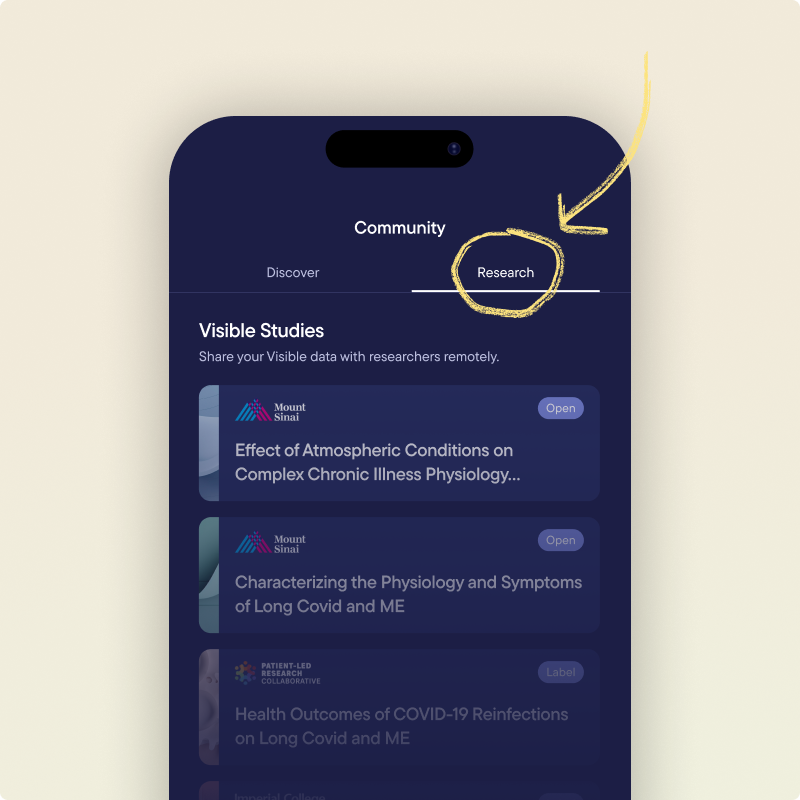
To get involved, open the app and go to the Community tab, then Research. There, you can see studies you may be eligible for and choose whether to take part.
.png)