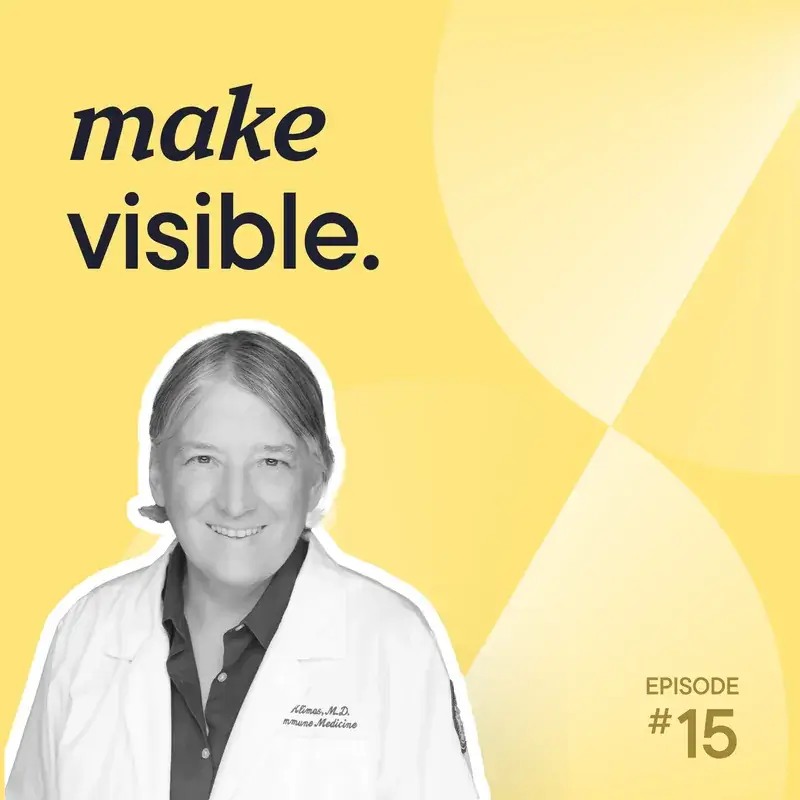
Monoclonal Antibodies and the Future of Complex Illness Treatment
With Dr Nancy Klimas
A new clinical trial is underway to test a monoclonal antibody as a treatment for Long Covid.


Episode transcript
Emily Kate Stephens (0:07): Welcome. Well, it has taken a while and quite some effort, but a new study looking at monoclonal antibodies for the treatment of Long Covid is finally underway, and I had the pleasure of discussing it along with her decades of research into ME/CFS and other complex conditions with Dr. Nancy Klimas at the Institute for Neuro-Immune Medicine at Nova Southeastern University, along with the deep investigative science that they undertake, we discuss existing ways to manage and treat patients, helping move the body back to homeostasis. What an absolute pleasure to be in the same room as this inspirational doctor, scientist, researcher, and thought leader. And I hope that you enjoy this interview as much as I enjoyed speaking with her, Dr. Klimas. I am very excited to be here in person. What we're trying to do at Make Visible is try and bring some of the research that people like you have been doing for decades into illnesses that have not got necessarily that much attention in terms of the actual global attention, and pull those strands together. So I came to this from having Long Covid, but what has become so apparent to me is that emphasis on Long Covid and the funding that has gone into Long Covid has enabled us to actually start looking and start piecing together pieces in conditions like ME/CFS, which has been much underrepresented historically, not underrepresented by people like you or Lucinda Bateman or these people that I have spoken to who have been working extensively and tirelessly for decades out there in the world. It has been underrepresented. Your focus is research and clinical efforts.
Nancy Klimas (49:50): So it took us a while to get that one rolling back again. But now that's finally off the ground, and we have a study on the microbiome using probiotic types of treatments to try to get a less inflammatory
Emily Kate Stephens (50:05): Because that those are the kind of things that you actually advocate for, aren't they? Using prebiotics, probiotics,
Nancy Klimas (50:12): Using food as a therapy. It's really important. And if you looked at the diet of people who are too ill to stand in the kitchen, you'd be shocked what they're eating. They're just
Emily Kate Stephens (50:23): Not getting the nutrients. They're
Nancy Klimas (50:24): Not getting the nutrients. They can't get better if they don't get the nutrients. But also, nutrients are anti-inflammatory. Nutrients are they're things to know about your diet that can help your immune system recover, and that's really important.
Emily Kate Stephens (50:37): So, if there was one thing that I asked you for people with chronic illness to consider, or just to think about, if there was one piece of advice that you could give them. Would that be yeah? I know. Would that be nutrition today, or would that be?
Nancy Klimas (50:53): That's a thing, you know. But I say it's a layered approach, and they're all important. Restorative sleep. How important is that? You know, I mean, it's not an easy thing to achieve, but that's when you heal. That's when you mend. There's actually a flow of something called glymphatics in your brain that reverses its direction when you're asleep and detoxifies your brain. You need sleep to detoxify your brain. That's terribly important. You wouldn't even think these two things are connected, but boy, are they connected, you know. So, yeah, anti-inflammatory foods and nutritious foods. Never putting anything in your mouth that's not going to actually help your body. That makes good sense. And get restorative sleep and have a family that loves and supports you. Keep your networks together and love them back for it, and support them. Be a part of the love circle. It's really important. There's so many parts to this. What do you say? And then yeah, the immunologist says take good care of your T cells, but that's you know trickier. And yes, your microbiome matters because it really messes up your whole body if it's wrong. That matters, yeah. That's true.
Emily Kate Stephens (52:05): I've had a whole hour with an immunologist, and we haven't talked about the T cells, have we? Okay, that's for another time. That's for another time. And in terms of this going forwards, outside of what you are all your team is doing here, which is incredibly exciting. And talking to Dr. Theoharides as well, it just seems that you are all so involved in interesting areas. Who is doing exciting work, or what is exciting outside of the work that you're specifically involved in? Because you every time we talk, you mention so many people, but
Nancy Klimas (52:40): There are so many good people. I mean, I don't know that this
Emily Kate Stephens (52:44): Network about the way that you all collaborate. It's absolutely amazing, and it's not just within your country. The collaborations that you seem to have outside as well. No,
Nancy Klimas (52:54): You got to be international. In fact, I love. If you look at our group, our clinician group, we have someone who's born in Russia, someone who's born in Poland, someone who's born in Israel, someone who's born-I mean, everyone's from somewhere else, right? And when you talk, and they learn medicine there. So when they come to me with my U.S. Not just Western, but U.S. Western medicine, and I realise, man, am I in a little box? These guys know things I've never heard of, and so I long ago committed to going to international conferences and learning from everybody because they bring so much to the table, and I've learned a lot that way. It's been it's really helped us and helped us develop our ideas and our thoughts.
Emily Kate Stephens (53:43): I continue to be blown away by the people operating in this field, the level of dedication from people like Dr. Klimas and her entire team there, and I have to tell you that the facility at the Institute for Neuro-Immune Medicine is phenomenal. The people that I met were so dedicated to rigorous, robust science and compassionate care. And as Dr. Theoharides said in episode 13, they are truly thinking outside the box and look at these conditions in a multifaceted way. I feel that people are in safe, progressive hands under their care. I am genuinely humbled by the people that I meet working in this field. So, whilst I wouldn't wish chronic illness on anyone, I am so grateful for the path that my life has taken that enables me to have these conversations. Thank you to each and every one of you who contribute to this research, to this care, and to making progress for patients and our medical understanding at large. Thank you for listening to Make Visible. Please do like, follow, or subscribe to listen to our next episode, where we'll be uncovering more insights into complex chronic illness. This was brought to you by the team at Visible, a group of scientists and engineers whose lives have been affected by energy-limiting health conditions. We're building wearable technology that's helping 100,000 people measure and manage their complex chronic illness. To find out more about what we're working on and how Visible could help you, visit our website at makevisible.com.